Sunday, June 13, 2010

ANZACs at Gallipoli


As we set out on the Kiwi (and Aussie) pilgrimage to Gallipoli our group of 10 watched a documentary on the Gallipoli campaign on the bus. We got the low-down on the politician’s reasoning/strategy which ignored numerous intelligence reports and warnings to launch the offensive, and saw personal letters and diaries from soldiers and commanders on both sides revealing their mindset and the atrocities through which they endured (and many who didn‘t). We had the futility of the war which raged on this peninsula refreshed in our minds.

But no documentary can compare to standing on the cliff above ANZAC Cove and seeing the landing site where the troops were mistakenly landed and had to climb the cliff with full (and wet) combat gear. Or looking beyond the graves of 17 year old “soldiers” to the narrow stretch of water that was the reason for the whole conflict. Or standing on a stretch of ground shorter than a rugby field that thousands of men sacrificed their lives for.

Surprisingly, the most memorable part for me was not the ANZAC, Australian, New Zealand, nor British memorial sites, but the Turk memorial. It has a quote from Ataturk - the Turk commander who went on to found Turkey after the war - that sums up the sentiment between the opposing troops, and which lives on today. Though it was their duty to shoot at and blow up each other every minute of every day, both sides also lobbed tins of food and cigarettes to each other across the trenches, and during ceasefires that were called to bury the dead they would shake hands and share family photos. This quote manages to encapsulate the kinship that the Turkish people reserve especially for ANZACs:

“Those heroes that shed their blood and lost their lives…you are now lying in the soil of a friendly country. Therefore rest in peace. There is no difference between the Johnnies and the Mehmets to us where they lie side by side in this country of ours…You, the Mothers, who sent their sons from far away countries, wipe away your tears; your sons are now lying in our bosom and are in peace. After having lost their lives on this land they have become our sons as well.”

This is the kind of understanding and tolerance that Turkey was founded on, and makes it such unique member of the Middle East community today - it is a close ally to both the USA and Iran, and up until the recent events with aid ships, has been a close supporter of Israel while being a nation that is 99% Muslim.

So here are another two (more recent) quotes from some less famous Turks that have stuck in my head:

“We Turks, we LOVE Kiwis and Aussies” - Close friend of Hayden, our local Istanbul Kiwi.

“Turkey is an Islamic country, but we have no issue with Jews, or any religion. We have no problem with an Israeli state. We are angry because the country of Israel attacked and killed our civilians” - Driver of a carpet van who picked us up off the side of a country road and gave us a ride back to the village where we were staying.

The Turks that we have met are unbelievably patriotic under their nation‘s flag, yet retain an individual identity (family, religious, ethnic, regional, and more) just as strong, all the while tempering it with a rational tolerance for others. This has been one of the best things about Turkey for me, and continues what is becoming a theme of the trip so far - breaking the negative, one dimensional stereotypes and interpretations offered by news and media, and finding that the world isn’t nearly as scary as it’s made out to be.

Monday, June 7, 2010

From Asia to Europe, and back again


We have been told that Istanbul is the only city in the world which spans two continents(Europe and Asia), and though Brad and I weren’t so sure of this “fact”, we were very sure that we had landed somewhere entirely different to Iran. Arriving at our hostel in the Old Town was like arriving in the middle of a rock concert, except that the draw card of music had been replaced by tourism. Edging our way through thick, sweaty crowds of middle aged white people with large cameras resting against even larger bellies, it was dawning that the tour buses lining the streets were to be a daily reminder of how lucky we had been in Iran.

It took a few days to become accustomed to the ever-present throngs of tourists, and this week allowed us to cover such must-sees as the Blue Mosque, Topkapi Palace (now a museum), the Grand Bazaar, and plenty more, but personal highlights were:
  • Sitting on the ruins of a cliff top Roman Fort at the Black Sea entrance to the Bosphorous Strait, watching the ships roll on through. Well away from the hustle of the city, we could see all the tankers waiting to pass through the only route out to the rest of the world, and realised how important diplomacy must be in this part of the world - Turkey has control over the main trade route with the world for 6 other countries. No wonder people have been fighting here for thousands of years.
  • While searching for the spice market, we discovered a little Turkish sweets store which was filled floor to ceiling with various lollies, chocolates, puddings, cakes, and of course, Turkish delight. What made it different to any other sweet store was that it was run by a kind old man and his posse of nice young ladies, who all took delight in handing out more tasters and samples than we could keep up with, with no obligation to buy. But of course we did buy. A very dangerous place.
  • Catching the ferry to the Asian Quarter and wandering the quaint little cobbled streets and alleys in search of a good quality backgammon board from an honest shopkeeper (who only started his price at 15% higher than the true price, rather than the 400% standard in the bazaar). Now I can fuel my addiction anytime I can find a willing adversary!
  • Emma flew in from NZ, her 24 hours in transit meaning that she wasn’t in the best shape when we went for a Turkish Bath that night, so she opted for the massage-only option. Brad and I proceeded to lie on a marble slab and be beaten up by a large Turkish man in a towel and moustache. Not the most relaxing experience, but definitely very atmospheric, chilling out afterwards chatting to other travellers in the centuries old bathhouse steam room.
  • Emma’s friend’s fiancĂ©e’s mate runs a tour company in Istanbul (there’s that Kiwi 3 degrees of separation rule!) and took us to an ultra cool little known rooftop bar, frequented by local arts students and film directors, where we had a few drinks and watching the sunset over the city while getting to know it from a local Kiwi‘s perspective (ultra chilled out and modest, rather than Turk-style of ultra passionate/energetic with forwardness that sometimes borders on aggressiveness). Hayden then sorted us out for the next 10 days, making sure that we see the best of Turkey at the best price - go Hayden!

After wandering the town for days we came to the conclusion that this bustling city of 15 million people, two continents, thousands of years of history, and various religions all living together under the same flag, with a patriotism that seems to overcome all other divisions, would be a great place to live - if it weren’t for all the tourists!


Next 10 days include: Gallipoli; Troy; Pergamom; Ephesus; Pammukale and Cappadocia. Basically an anti-clockwise loop down the Aegean Coast, and across central Turkey.

Next 3 months include: Turkey Mediterranean coast, Greece (Crete, Islands, Athens), Croatia(?) Italy (including 3 weeks working on an organic farm and winery on the Amalfi Coast). All suggestions and tips are welcome!)


Photo: Sipping Chay on the streets on Istanbul

Monday, May 24, 2010

Bye bye Iran


Like nowhere I’ve ever been before, leaving Iran feels like leaving home. In just 3 weeks we’ve met so many amazing people, we feel as if we have friends and family in every major city (and some less major ones). Usually I leave a place reluctantly, in the knowledge that I probably won’t return due to the fact that there are so many other places to go and see , and a taste is enough before trying something else. But Iran’s people make it unique, and I have the feeling that this place is more like fine wine - if I manage to make it back here, the experience will be even richer than before.

When I left New Zealand, most people were (understandably) curious as to why I would want to go to Iran - after all, isn’t it just all desert, nuclear weapons plants, and terrorists? Well aside from the fact that reality could not be further from this, there are obviously a number of things that could be better about Iran (mostly in relation to government) - but there is also plenty of amazing things that Iran has and which we in the West could learn from. Not so briefly, my “Best of” Iran:

  • Ta arof - A custom whereby everyone is super generous to everyone else, even if you can’t afford to be. Everyone else is expected to turn down any offer three times before accepting, allowing someone to offer something up to three times and appear generous, even if they can’t afford to give it away. Some people found it silly and fake, but there is a fundamental difference in social interaction which this seems to encourage - people’s default action is to offer help and assistance to others. In the West people seem to think “Me first, then maybe I’ll offer help to someone if they look like they need it”, whereas Iranian people have the mindset, “Offer help to everyone, and if they need it more than me, then they might accept”. Although offers such as “no charge” for a taxi ride are clearly not meant to be accepted, we were offered (and often accepted) many a meal, snack, helping hand, set of directions, or bed for the night that were genuine offers to help.
  • The importance of family. In Iran, family time and functions are top priority. Hanging with your family (immediate and extended) is what people do rather than filling their schedules with work, fitness, more work, and anything else that could be added to the “goal achieved” list in their head. They still manage to study to PhD level, be high level sportspeople, devote themselves to religion, and pursue careers - but these things are not nearly as important as having a meal with the family. While living with my Grandparent for a month before departure I appreciated that there is nothing quite like spending time with and getting to know your family, and this is something that I envy about my new Iranian friends.
  • Pineapple Lump Soap! Iran may not have the technology to enrich Uranium to weapons-grade levels (yet), but we can definitely learn from their other top secret technology. Our hostel in Yazd had soap that smelled exactly like Pineapple Lumps - this is what we should be trying to find out more about.
  • Sit on the grass - with all the grass in NZ, it’s not that often that people stop and enjoy it. Here parks are filled with people relaxing, having picnics, throwing a ball - and it’s not unusual to see tents pitched in random fields as you drive between cities, with families having a picnic or just enjoying the countryside. Maybe it’s because there’s no alcohol, and there are restrictions on access to rubbish TV and internet - it seems that everything has a silver lining.
  • History. Alexander the Great, the Persian Empire(s), Genghis Khan et al. Not to mention recent history of British and American backed coups, religious revolutions, Iraq/Iran war, and more. This place has it all - so many stories to tell.
  • Don’t plan out every hour of the day - take the time to be social. The number of times that we went to lunch and stayed until past dinnertime, or dinner and stayed beyond midnight, well outnumbered the times that we finished our food and left soon after. People don’t use the excuse of “work”, “to-do lists”, or anything else to cut short social occasions. Often if there are dinner guests, mattresses and blankets will appear in the living room, and the guests will stay the night and go home the next morning - people just talk themselves to sleep.


There are also a few things that are not so great about this country, and these affect the citizens far more than they do anyone else. Rather than give my (relatively ignorant) opinion on what needs to change here, below are some of the most salient points from the Iranians that we met along the way:

  • Freedom of information and expression - Rather than restricting people and the information available to them, allow everything but encourage and educate the benefits of preferred behaviour - by telling people that they can’t have something, they will try that much harder to get it. The current situation has the best parts of Iranian culture being eroded by people who are latching onto the worst of western culture (satellite TV) and mimic it in the (false) belief that it is how to be a “developed country”.
  • Charity begins at home. The government should be concentrating it’s efforts on helping it’s own citizens, strengthening the beautiful culture and sharing this with the world (to Iran‘s benefit - socially and economically), rather than giving away money - no strings attached - to countries such as Afghanistan, picking fights by denouncing western nations such as USA and Britain, and talking about wanting to nuke Israel.
  • Freedom of choice - women being forced to cover themselves with headscarves is widely held up as an example of unnecessary and disliked law - we met a number of women who would choose to wear headscarves even if it was not compulsory, and also a number who were devout Muslims but severely disliked the requirement to cover themselves in public.
  • Freedom of religion - many of the younger people that we met confessed to not being practising Muslims, and that although many believed in “a God” and a value system that reflects the majority of morals of Islam (and a number of other formal religions), they disliked the State brand of Islam.


I've never been one to learn new languages (the brief attempt at Mandarin last year was driven by economic aspirations), but right now I would love to learn Farsi - the people of Iran have so much character, intellect and passion to share, and they love to share it - if I only I could communicate with them (without the help of English speaking friends).

When one of our Esfahani mountaineers said, “I think…[pause for thought]…Persian people, they steal… your heart”. At the time I wasn’t sure whether it was a question or a statement, but judging by the regret with which Brad and I are leaving Iran, I’m thinking that it was probably the latter.


Photo: I spot a break in the manic Tehran traffic and run out into the middle of Imam Khomeini Square for a pic - note the snow-capped mountains on the edge of this 14m person capital city!

Sunday, May 23, 2010

What began in Shiraz...


When up the mountain in Shiraz we had looked down into a football stadium while a game was on, and have since been trying to go to a game here - the deafening chants, singing, and even flares were just too much to miss out on. Luckily, Mohammad got in touch with us as we were leaving Rasht, and picked us up from the bus terminal and took us straight to a game in Iran’s largest stadium. Though only a mid-week derby match, the teams who were playing were a big deal, and had thousands of supporters to make sure that the air was nothing anywhere close to “calm”. Even one of the coaches had his own fan club - one section of the stands held a few hundred fans who didn’t support either team, but spent the 90 minutes cheering everything that Sepah’s coach did or said. Slightly different to the attitude taken with All Blacks coaches in NZ!

The next day we had lunch (which, not unusually, carried on until 6pm) with Mohammad and his girlfriend Mahin, who is studying for her PhD in Sociology/Urban Planning, and has more spark (in her eyes, mind, heart, and tongue!) than anyone I’ve ever met. Mohammad meanwhile, is one of the kindest, gentlest, and warmest people ever - they are perfect for each other, and Brad and I thoroughly enjoyed all of the time spent with these two (and their friends) over the next few days - even when they went into in-depth discussions in Farsi, just watching and listening was fascinating and highly entertaining! Fingers crossed, there will be a good reason to apply for another visa next year…

We also met up with our dinner friends from Shiraz on our second day in Tehran, ordering some ridiculously good icecream sundae milkshakes, then spending all of Friday at their place (another noon-10pm mega-lunch prepared) and in one of Tehran’s famous parks, watching locals and hanging with the girls, their friends, Mum, and Barfi the dog (“Barfi” translates to “Snowy” - think Tintin). Though we spent most of the time conversing through Neda who had excellent English(and did incredibly well translating for the entire time), we all got to know each other really well and were sad to say goodbye.

Other Tehran highlights:
  • Getting hopelessly lost, then caught in a thunder storm, on the only night that we tried to go it alone in a city of 14 million non-English speakers.
  • Golestan palace - never have I seen rooms more ornate - or with more mirrored surfaces
  • Crossing the road - reminiscent of Beijing/Shanghai/Bangkok, but with less rules, and more speed.

Picture: Ridiculous icecream sundae milkshakes

Not your usual tourist stop…


After meeting Hamed at Perspolis, we pretty much had to accept his invitation to come and visit in his home town of Rasht (in the North West). Not usually a stop for tourists, Rasht is the capital of Gilan province and was completely different to the towns visited so far. The Gilan province is seen as being different from the rest of the country, has it’s own dialect which isn’t understood (or even taken seriously) by the rest or Iranians, and the locals feel that central government has neglected the province -and it’s people - for years.

Our first impression when going with Hamed and his mate Farid was that we had stepped into a cell of the resistance. Hamed’s bedroom was totally custom built and soundproofed - all walls, doors and ceiling covered in 5cm of polystyrene and 3 layers of cardboard egg-tray - with “subversive” posters of Al Pacino (Scarface) and Kevin Spacey (American Beauty) lit by the dim yellow-tone bare light bulb.

But these measures had not been taken to prevent radio surveillance by government forces trying to seek out rebel forces - there were merely because Hamed’s one love - rock music - is forbidden in the country where he lives. He has been playing the drums for 15 years, and along with Farid has recorded a number of demo tracks, but can’t play outside of his bedroom for fear of being arrested. And it’s not like his music is freakishly offensive - strong influence is drawn from Western chart-topping bands such as Pink Floyd and Radiohead.
The two days spent with Hamed and Farid were filled with boundless generosity and disarming frankness, contrasted with a very strong measure of bitterness and resentment towards government and traditional Iranian culture. Every time we walked past a poster of a government minister (about every 100m on the street), we would hear that the minister is a puppet of religious extremism. Every time someone displayed Ta ‘arof (essentially an Iranian tradition where assistance, money, or food is offered even if it cannot be afforded, in the knowledge that it will be turned down at least 3 times before acceptance, allowing people to retain social standing even if they are not wealthy), we heard that it was “stupid think” and flase. And every time we saw the police, they were reffered to as “gangsters”.

Never having encountered this sort of world-view outside of literature and films, I found it a little hard to empathise fully, and at first wondered whether it was justified. Then we watched videos of riots taken from the cellphones of locals where peaceful political protests were being broken up by Basij (pro-government militia) taking to the crowds on motorbikes with batons, while more videos showed assault rifles firing live rounds into the crowds. We spoke to a friend of Hamed’s who showed us which teeth he had had knocked out and how many stitches in his head he had needed after trying to protect his girlfriend from police who had attached her in the street. And we wondered why his girlfriend ducked behind a tree and followed us at a distance when she saw police in town - although it is uncommon, friends have been arrested for being in public together in the past (it is illegal for single males/females to be in each other’s company: holding hands is an arrest able offence - if the officer feels like enforcing it).

This was a real wake-up for me, as up until now we had heard plenty of thought provoking dissent against the government, but nothing that truly struck home at an emotional level, making me feel “it’s not right to have to live like this”.

But true to Iranian form, Hamed and Farid made us feel like family - we stayed with both families, and Farid’s Mum cooked an incredible feast for us and his brothers and friends, before we went and had a boys night listening to music (not the legal kind), drinking homemade raisin wine (also not the legal kind), and having some great conversations (yep, you guessed it).

Like everywhere we had been, we did not want to leave our new friends and family in Rasht. They had opened our eyes, our minds, and our hearts to something we didn’t know before.


Picture: Brad and I with Hamed and Farid - sorry for the average photoshop job guys - am working on the road and just wanted to make that I didn't get you in trouble!

Staying with the Cowboys of Kashan


Staying with a friend of Mostafa and Ahmad, we stayed local style, sleeping on the floor of what was the equivalent of a student flat. Playing cards with the boys (local style), and learning yet more of what is forbidden in a society with very different rules and conventions to the one which we grew up in. And more interestingly, seeing the extent to which people have to alter their behaviour and habits just to enjoy what those who live in the West see as basic personal freedoms.

Mostafa, the KingPin of Kashan, put his extensive local knowledge and networks to work, while Ahmad made sure that we knew what was going on everywhere we went and that we got the most out of it, even offering us “Portugal Juice“. We saw the best of Kashan and nearby Niasar, including:
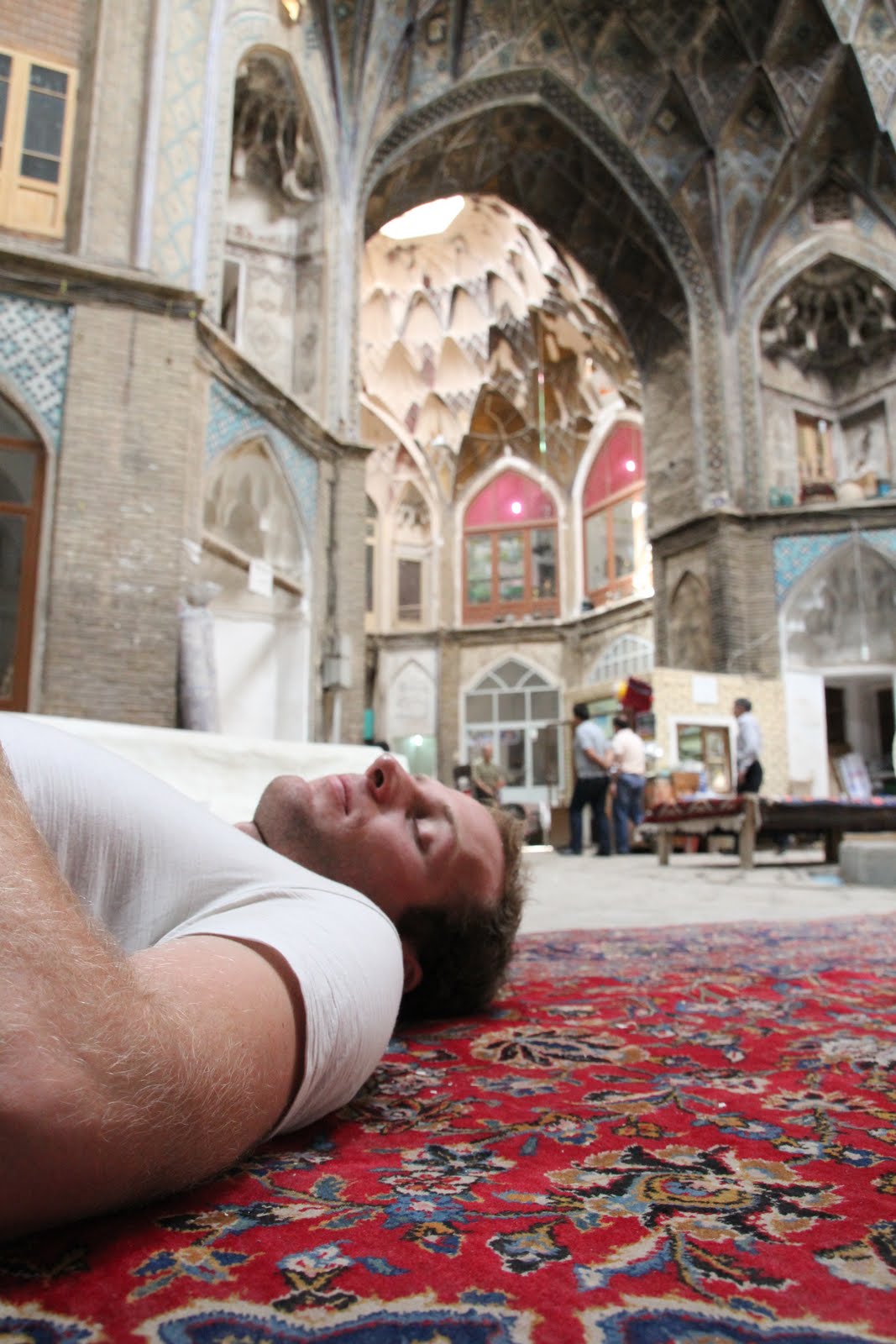
  • A meal in the bazaar’s caravanserai - originally built to lure traders to the village for overnight stops to boost the local economy - with the necessary post-Abgoosht coma on the Persian carpet
  • Walking onto the set of a historical film about Iran’s military coup, and talking to an old local man who told us that he “doesn’t need to watch a movie - he was there for the real thing” - so we got the historical low-down from an eye-witness
  • Seeing the traditional method of extracting scent from flowers to produce rose water - and then eating a tub of icecream with rose water syrup drizzled over it.
  • Learning that in a city where the daytime high can sometimes hit 50 degrees, it’s wise to follow the locals and walk in the shadows of buildings
  • Learning that by driving 20min out of town, the intense heat can bee replaced by intense rain, waterfalls, and greenery (and that if we had gone a further 45min, we could have been in snow).

An awesome couple of days, and a big thanks to the Kashan boys - keep in touch!

Esfahan - Half of the World...


Uh oh - yet another case of travel fatigue. Our first few days in Esfahan - famous as Iran’s cultural and heritage capital, and nicknamed “half the world” - seemed empty of life. Wandering aimlessly through the bazaar, seeing more ancient mosques, and dodging super persistent carpet salesmen, we came home to our well-below-average hostel each night drained and with a feeling of something well less than achievement.

Then we met Sam(aneh), whose energy, friendliness, strong opinions and penetrating questions gave us a new lease on life. She sorted us out with a local simcard, showed us a mean combination of carrot juice, icecream, and some sort of noodley stuff, and led us ducking through the low arches of ancient bridges (Sam didn’t have to duck) which form the social hub for local Esfahanis.

The next night Sam took us to meet her friends, who had us in stitches for hours. Fardin - a personal trainer - would explain that he preferred girls who were fuller in figure - because it was good for business! This statement alone gave the others enough ammunition to tear him to shreds for close to an hour. We couldn‘t understand everything that was being said (often translation was hindered by raucous laughter) , but the intensity and animation of the others meant that our cheeks were sore from laughter by the time we went home to his place. Here Fardin showed me the ropes of Backgammon, as my Sensei he would help me along just enough to win the odd game and spur my competitive spirit into agreeing to “just one more game”. Needless to say, I am still definitely the student, and he the master, but it took until 3am for this to become evident.

With a solid two and a half hours of sleep behind us (the girls had none) we went to meet more friends at the mountain - it’s what Esfahanis do on a Friday. Arriving at the base of the mountain at 6am, the streets were already lined with hundreds of cars, and people were thronging at the gates to the park. Our crew of fourteen spent about 4 hours climbing and walking all over the mountain, with a break for breakfast in a secluded nook about two thirds of the way up. During this time we found that every single one of the group shared the kind, open, intelligent and hilarious qualities which we found the evening before, but all in their own unique way. Some were loud and argued passionately, others discussed things quietly, while at least one person was always making sure that laughter was in the air (not naming any names!). A great morning with an incredible group of people - the sort who you wish the world had more of - finished with a relaxing (non-alcoholic, peach flavoured) beer under the trees at the base. Ahhh.

That afternoon we said our goodbyes and went to the most famous of Esfahan’s bridges, where on Fridays men will sit among the arches under the old stone bridge and sing the afternoon away. There is something very calming about sitting under a 400 year old stone bridge with locals, listening to melancholy songs of Persian culture - you don’t need to understand the lyrics to appreciate it.

I would have loved even more to have experienced this a few years ago though - before singing (by women) and dancing (by anyone) in public were banned. According to the stories, there were some great times had under that bridge!

After a quick runabout on the river in pedal boats with fellow mountaineers Mostafa and Ahmad (where we raced, and beat, a boat of local guys - perhaps bending a rule or two), we jumped on a bus with them to head North to their home town of Kashan.

Other highlights of Esfahan include:
  • Sharing music with Mahsa, adding a dash of much wanted Persian flavour to my iPod
  • Discovering Abgoosht in the bazaar with a local named Ali - a classic Persian dish where you get to drain the liquid from a chunky soup and down it with a liberal amount of Iranian flat bread, before taking to the remaining chunks (split peas, meat, veges etc) with your very own masher, and demolishing the pulverised product with yet more bread, yoghurt, and raw onion. My favourite dish yet (perhaps because it requires you to play with your food, and really get to know it before eating it).

Wednesday, May 12, 2010

Into the Desert


The first signs of travel fatigue were showing - every day being filled with exploring new places, meeting new people, and overcoming significant challenges such as “who will be able to answer me when I need to find the bathroom next?”

This was exacerbated by a half day group trip around some historic villages and temples out of the city, where we plodded along listening to the guide decide aloud just how many hundreds or thousands of years old a particular building was. Quote of the day: “This Mosque is very ancient, and new”.

Then, when every headed back to the city, we grabbed a driver and got him to take us into the desert. We drove for another hour into the wilderness, through a tiny oasis town, and into the giant sand dunes beyond. Here is where we overcame travel fatigue with total freedom in the dunes. There were bails down the steep dunes, some wild camel stalking, and even a bit of Frisbee. Then we finished off with some tea around the bonfire with our driver under the stars - so Bromantic. Arriving back at the hostel after a 2 hour drive back to civilisation, we were totally refreshed and exhausted.

Photo: Dune jumps (followed by dune bails - photos to come once we're out of Iran)

In the Lioness’ Den

In Iran it is illegal for women to be in public without having their head covered (usually by a headscarf or chador (full robe with face showing). Muslim/non-muslim relationships are punishable by death. I had been approached by local males who respectfully asked me not to take a photo when there was a group of schoolgirls (all in full chador) in the background of the shot.

So when Brad and I were walking home form dinner in Yazd (an isolated desert city of 500,000 people) and a looked into what seemed an empty meeting hall, and had a man come onto the street and insist that we come inside and sit down among at least 20 women - many with their hair out and chadors off - we were a little non-plussed. A lady with excellent English came and sat with us, explaining that a women’s prayer meeting had just finished, and all these girls were extended family (they are allowed to be uncovered in private, and the only male was their Father who had pulled us in off the street). As we sat talking with the lady, her father, sisters and cousins started delivering plates of food, cups of tea, and more plates of sweets to us, each of them welcoming us to Iran with a kind smile.

Aside from the second dinner and further enlightenment to the curious fine print of Islamic and Persian conventions, the really enjoyable part was the family atmosphere. We were a part of a family gathering of over 20 people, all of whom were sitting around and just enjoying each other’s company, and we felt like the guests of honour. These meetings happen a number of times a week, and it seems that for all the restrictions in Iranian life, a huge plus is how close the families here are. Before leaving NZ I lived with my grandparents for a month or so and thoroughly enjoyed every bit, just as I do being at family gatherings, but as the lady said to us, “Westerners are much busier, and so don’t have time for family”. Iranians make it clear that they are envious of people in foreign countries who can wear what they want, say what they want, and do what they want, but we made it clear to our hosts that night how we envy and admire the Iranian pace of life and culture of family. Brad and I have since been discussing: how much of this culture would be kept if the floodgates of personal freedom were thrown open?

Shiraz, but no wine


We didn't realise it, but flying into Shiraz provided our first insight into the Iranian people. The plane was filled with cheerful, friendly people who chatted in a very relaxed way, and an older man used what few words of English he knew to make it clear that he was happy to have us visiting his country, and to welcome us on behalf of all of Iran. As the plane started it’s descent, two girls in their twenties wearing singlets and plenty of jewellery disappeared into the toilets, and reappeared moments later in long sleeves and headscarves, still managing to show plenty of personality, individuality, sophistication…and fringe.

All of this didn’t really register with us at the time, as we were slightly apprehensive due to media coverage of Iran, warnings from friends, family and government, and the fact that we seemed to be the only non-Farsi speakers on the plane (and without question, the only “Whiteys”). We were busy asking the flight attendant for tips on what to do that we would have missed the bus from the plane to the terminal had it not waited for us with everyone smiling (why was an entire plane load of people happy to see us onto the bus when we had just inconvenienced them for over 5 minutes?? This was definitely not Auckland).

Once we found ourselves lost and alone in the arrivals hall, a local PE teacher with a decent grasp of English approached us and kindly helped us exchange cash, get tourist information from the ultra-camp Tourism Officer (doesn’t the govt. say that “his kind” doesn’t exist here?), and get a taxi to a hotel. No-one tried to scam us, no-one was impatient with us, and yet more people came to introduce themselves, welcome us to their country, and offer their help.

After a day of finding our bearings and being welcomed to Iran at least once every 100m of footpath, we hit Perspepolis to see the centre of Darius’ Ancient Persian Empire, and the place that Alexander the Great eventually burned down after he finally defeated the Persians in 330BC. To think that we were strolling the same pathways that the royals of various ancient empires strolled thousands of years ago was pretty special, even if we weren’t allowed to drink royal wine and party like they did.
The day at Persepolis was also interesting in another way. We met a guy (we do know his name, but don’t want to publish it) from Rasht (Northern Iran, who talked to us about his passion for Heavy Metal (citing bands such as Bon Jovi, Pink Floyd and Radiohead), and how he has played the drums for 15 years but cannot do anything outside of his basement as this music is illegal. His passion was overflowing, to the point that after speaking for just a couple of minutes he seemed on the verge of tears. Realising this, he then changed the subject to us, and after 10 minutes he had invited us to stay at his place later in our trip - I hope that we make it there, if just to share music collections!

On the way out we were approached by another local, who ended up giving us a ride to the bus station in his car, and he proved to be the most interesting and Iranian person I have met so far. Dressed far better than most corporate types in Auckland City (everyone here wears collar and dress pants, but he was a step above this), and incredibly softly spoken, his words were laden with kindness, wisdom, and sincerity. After the usual “welcome to my country”, he went on to ask us about our backgrounds, then managed to:
told us not to be so stingy (we were using the $2 minibus rather than an $8 taxi back to town), and
shared his opinion that his President was “foolish” for his stance on foreign relations, and
his opinion that the “Arabs [UAE] are very foolish” for forcing their women to wear full face coverings

All his messages were delivered with a conviction, sincerity, humour, and wisdom that was completely inoffensive while being penetrating and very memorable. And he was a cattle farmer. The best proof yet of the Persian’s very friendly, gracious, sophisticated, kind, humble, and overall very human nature.

Other highlights of Shiraz included:
  • being asked over to sit with four girls from Tehran (capital) at dinner one night - we were under the impression that unmarried guy/girl interactions were a pretty sensitive subject, and that muslim/ non-muslim guy/girl interactions were to be avoided (if these relationships are sexual, they are punishable by death). So we were pretty chuffed to be asked to share dinner with four single local girls! A great example of how the West (or at least Brad and I) mistakes this society’s laws/conventions with how the much more entrenched Persian culture is played out around these laws (and has for many centuries). We have since been in touch with our new friends over email and are looking forward to having them show us around once we get to Tehran.
  • Daily conversations with highly educated and sophisticated locals, who breach topics such as religion and politics with refreshing frankness, while we awkwardly try to edge away from these sensitive subjects.
  • Lots of great food!
  • Discovering Iranian "beer". Alcohol is illegal, so there is "non-alcoholic malt beverage" in various flavours, such as lemon, apple, pineapple, and pomegranate. My favourite is Peach.

After just 4 days, Shiraz has leapt from the wilderness to easily placing in my top 5 travel experiences. It displayed its thousands of years of history and culture, the fact that Iran has the highest literacy and education rates in the Middle East, and the sophistication of poets such as Hafez (the Shakespeare of Persia) - and the people clearly love to share all of this.


Photo - Brad and I at Persepolis, Indiana Jones Style